
What retirement costs in all 50 states can look very different depending on where you live. A state-by-state study found a comfortable retirement could cost about $64,715 a year in West Virginia, while Hawaii came in at $186,062. That huge gap shows why location can have such a big effect on a retirement budget.
What Retirement Costs in All 50 States Really Shows
When I look at what retirement costs in all 50 states, the first thing I notice is the size of the gap. The GOBankingRates state-by-state study, published in June 2025, estimated the yearly income needed for a “comfortable” retirement in every state before Social Security was counted.
The study did not try to predict exactly what every retiree will spend. It used cost-of-living data and doubled estimated basic living costs under a 50/30/20 budgeting approach. I see this chart as a comparison tool, not a personal retirement price tag.
How the Study Defines a Comfortable Retirement
The retirement cost by state figures use data from the Missouri Economic Research and Information Center, the Bureau of Labor Statistics Consumer Expenditure Survey for retired households, and Federal Reserve Economic Data. The figures were collected through February 21, 2025.
“Comfortable” also means different things to different people. A person with no mortgage may need far less than someone paying high rent. Health costs, debt, travel, and family needs can change the number quickly. Our retirement calculator can help you compare expected income and savings with your personal goal.
Table of Contents
• What the 50-State Chart Shows
• How Comfortable Retirement Is Defined
• The Most Expensive States
• The Most Affordable States
• Why Location Matters
• Before Social Security
• Your Personal Retirement Number
• Using the Chart to Make Decisions
• My Bottom Line
What Retirement Costs in All 50 States at the High End
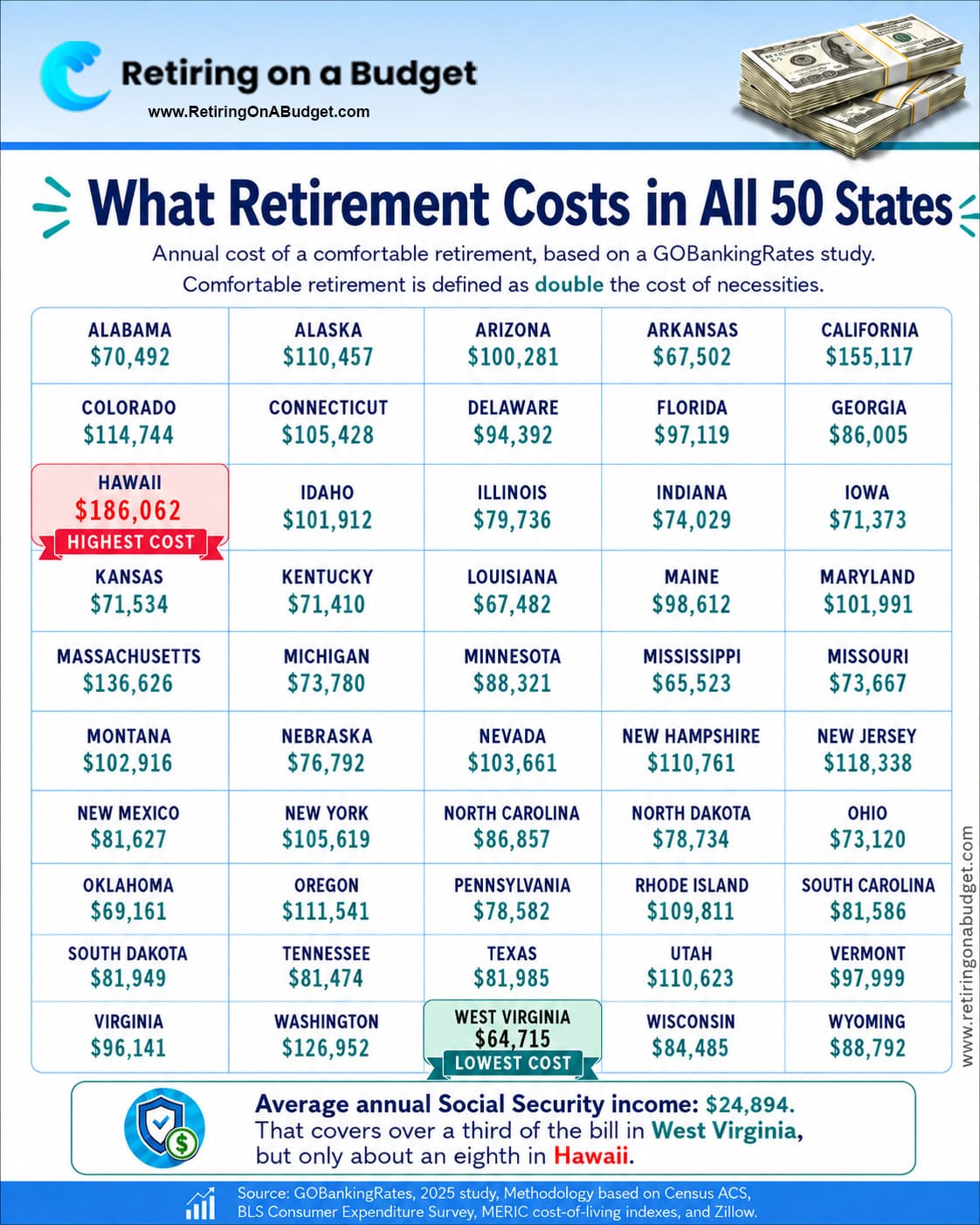
At the expensive end of what retirement costs in all 50 states, Hawaii is far ahead at $186,062 a year. California follows at $155,117, Massachusetts at $136,626, Washington at $126,952, and New Jersey at $118,338.
Housing can be a major reason one place costs more than another. Food, utilities, transportation, insurance, and other daily expenses also add up. Where you live can have as much impact on your budget as many smaller money-saving choices.
What Retirement Costs in All 50 States at the Low End
The affordable side of what retirement costs in all 50 states looks very different. West Virginia is the lowest at $64,715 a year. Mississippi is $65,523, Louisiana is $67,482, Arkansas is $67,502, and Oklahoma is $69,161.
That does not mean everyone should move. Family, friends, health care, weather, taxes, and quality of life matter too. Still, if you are thinking about relocating, retirement costs by state belong on the list of things to compare.
Why Where You Live Matters So Much
The biggest lesson I take from this chart is that retirement planning is not only about how much you saved. It is also about how much your lifestyle costs where you live.
For someone trying to stretch a fixed income, lowering monthly expenses can be powerful. Our free 100 Ways to Save in Retirement guide has practical ideas for cutting everyday costs without giving up the things you enjoy.
What Retirement Costs in All 50 States Before Social Security
The study looks at what retirement costs in all 50 states before Social Security is added. Most retirees do receive some Social Security income, but the amount is different for everyone.
For 2026, the Social Security Administration says the estimated average retired-worker benefit is about $2,071 per month, or about $24,852 a year. That would cover roughly 38% of the West Virginia figure but only about 13% of the Hawaii figure. The same average benefit has a very different effect depending on where you live.
Your Own Retirement Number May Be Very Different
I would never tell someone to use a state average as their personal target. Your real number could be much lower or higher. A paid-off home, low debt, a pension, part-time income, or shared household expenses can lower what you need. Medical bills or high housing costs can raise it.
When I think about what retirement costs in all 50 states, I see a starting point for questions. What do I spend now? What might go up? What income will I have each month? Those answers matter more than any national chart.
What Retirement Costs in All 50 States Can Help You Decide
A chart like this can help you compare choices before making a major move. If two states are on your list, look beyond the statewide average. Compare the actual town, housing, taxes, insurance, medical access, transportation, and the cost of staying close to people who matter to you.
If your budget is tight, our Senior Resource Guide can help you search for benefits, discounts, housing help, food programs, transportation resources, and other assistance. We also have a guide to food assistance for seniors if groceries are taking a larger share of your income.
The Number That Really Matters Is Yours
What retirement costs in all 50 states is a reminder that there is no single magic retirement number. The difference between the least and most expensive states is enormous, but your personal situation matters more than the average.
I would use the chart as a conversation starter. Find your state, compare the number with what you actually spend, and build a retirement budget around your own life. The goal is to know your numbers well enough to make choices that help your money last and let you enjoy retirement with less financial stress.